
In the factory
Each module gets its own rough-in while the frame is open: circuits from a module sub-board or a marshalling point, lighting, power, data and any specialist services such as emergency lighting or body-protected areas for a medical unit. The inter-module cables terminate at accessible junction points at the module edges, ready to be joined on site. Fit-off happens in the factory too, so the module leaves with its fittings, outlets and switches in place.
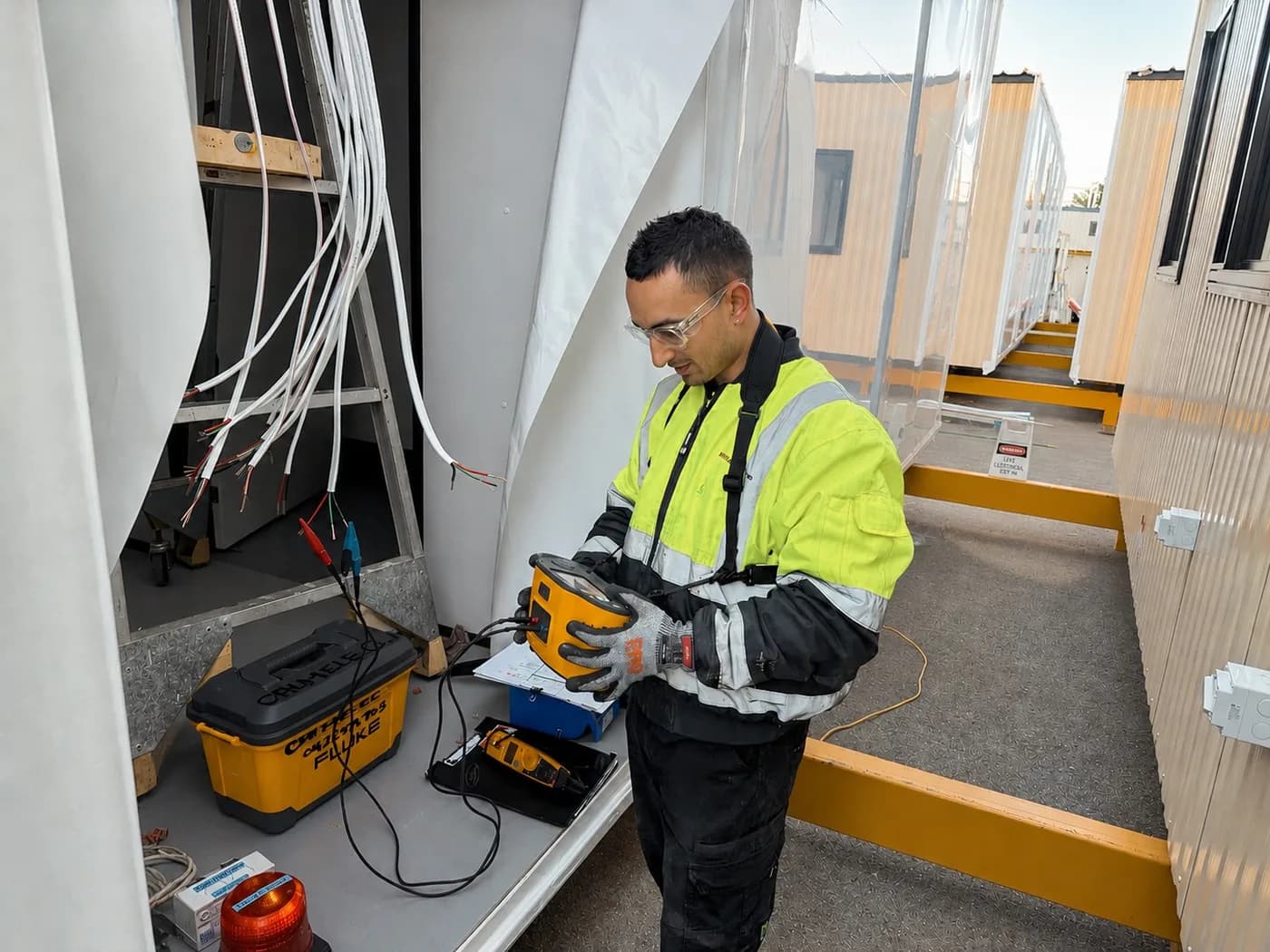
Testing before transport
Every module is tested as a unit before it goes on the truck: insulation resistance, earth continuity, polarity, and RCD operation on any circuits that can be energised in the factory. The results are recorded per module. This is what catches a screw through a cable or a missed earth while the wall is still open and the module is still at the factory, rather than at a site 300 kilometres away.
The switchboard question
The design decision that shapes everything is where the main switchboard goes and how each module reaches it. Options are a main board in 1 module with sub-mains to the others, a sub-board in each module fed from a common main, or a free-standing board on site. The right answer depends on how many modules there are, whether they'll ever be separated again, and what the site supply looks like. It has to be decided before the factory wiring starts, because it sets the cable sizes and the junction points.
On site
- Modules are placed and the inter-module junctions are joined and tested.
- The site supply is connected, whether from a new SA Power Networks service, an existing building or a generator.
- The whole building is tested as 1 installation: the same test set as the factory, now across the joins, plus RCD trip times and any phase rotation on 3-phase equipment.
- Emergency lighting and any specialist areas are commissioned and their initial test records created.
- A Certificate of Compliance is issued for the installation, and the site notification is lodged where the connection needs one.
What to check before delivery
- The module test records exist and are with the delivery paperwork.
- The inter-module junction points are labelled and match the drawings.
- The site supply capacity has been confirmed against the building's load, not assumed.
- Someone owns the site commissioning and the certificate. On a modular job it's easy for that to fall between the factory and the site.
We do both ends: factory electrical for modular building manufacturers and site connection and commissioning for the buildings when they land, across Adelaide and regional South Australia. If you're a manufacturer or a client taking delivery, the useful conversation is the switchboard one, and it's best had at the drawing stage.
Need this done rather than read about? See industrial electrician or request a free quote.