
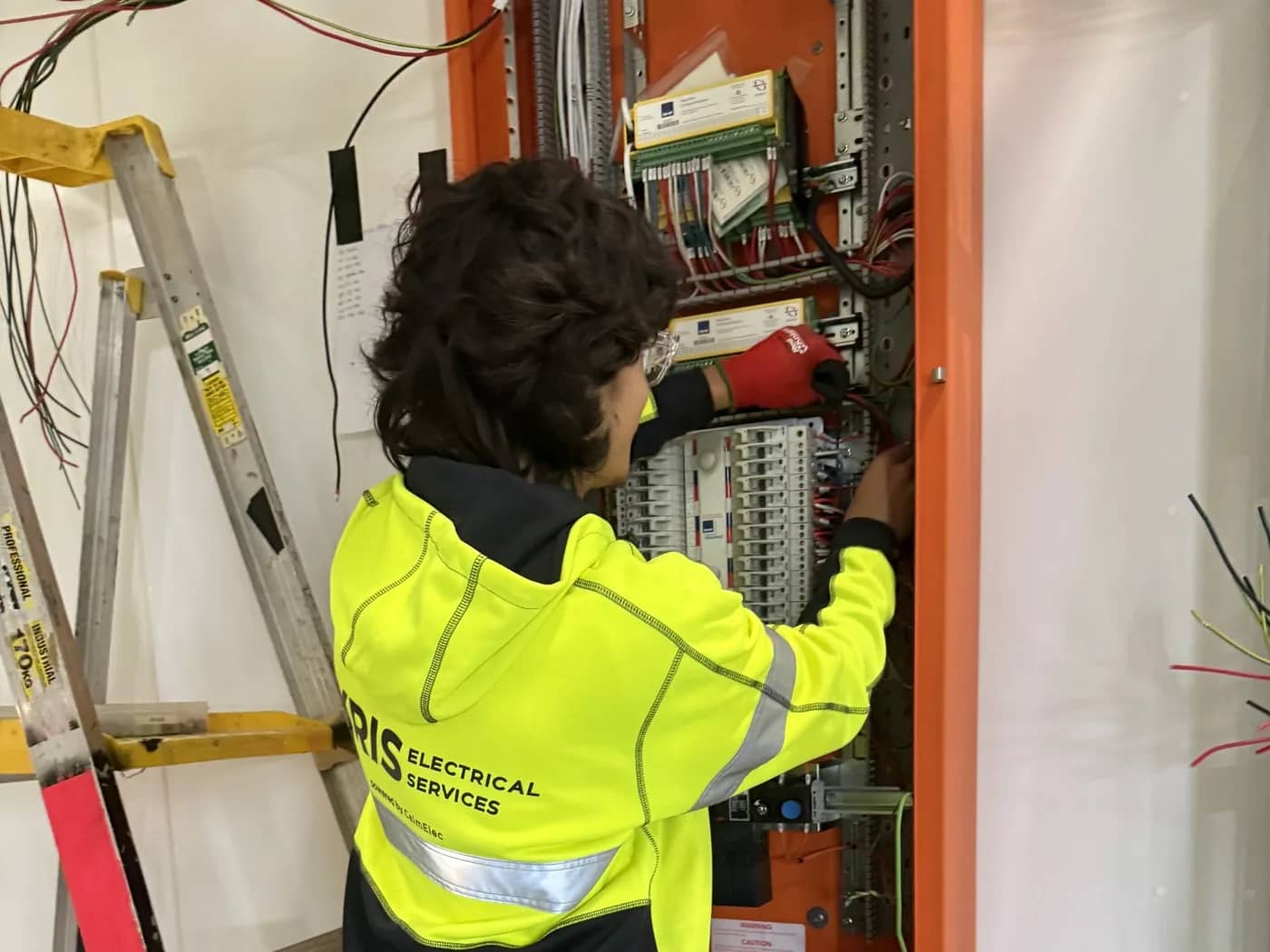
Start with the switchboard, not the charger
The question people ask is which charger to buy. The question that decides the job is what your switchboard and your supply can carry. A home already running ducted air conditioning, an induction cooktop and a heat pump hot water system may have very little headroom left, and a 32A charger is a significant new load on top of that.
We look at the main switch rating, the spare ways in the board, whether there is RCD protection on the final subcircuits, the consumer mains size and whether the property is single or 3-phase. That tells you what is possible before you have spent anything. If the board is full or dated, the honest answer is that a switchboard upgrade comes first, and it is far cheaper done once with the charger than retrofitted later.
What you can actually charge at
| Supply | Typical charger | Rough range added per hour |
|---|---|---|
| Single-phase 32A | 7kW AC | Around 40km |
| 3-phase 32A | 22kW AC | Around 120km, if the car accepts it |
| Standard power point | About 2.4kW | Around 10 to 15km |
Most Adelaide homes end up on a 7kW single-phase charger, and for a car that sits in the garage overnight that is more than enough. 22kW only helps if the property has 3-phase and the vehicle has a 3-phase onboard charger, which many do not. We would rather tell you that before you pay for the bigger unit.
What a compliant install involves
- A dedicated circuit from the switchboard to the charger. An EV charger never shares a circuit with power points or lighting.
- The correct RCD protection. EV charging can produce smooth DC residual current, which can blind an ordinary RCD. The installation needs either a Type B RCD or a Type A paired with the charger's own DC fault detection, depending on the unit.
- Cable sized for the run, not just for the load. A long run to a detached garage or a carport needs a bigger cable to hold the voltage drop inside limits.
- Mounting and protection suited to where it lives: weather rating outdoors, and bollard or height protection where a car could hit it.
- Testing and a certificate of compliance for the installation work, the same as any other circuit we install.
The installation standard for EV charging equipment is AS/NZS 3001.2, alongside the Wiring Rules. It is worth asking whoever quotes you which standard they are working to, because this is newer work and not every installer has caught up with it.
Workplaces, fleets and strata
Multiple chargers is a different problem from 1 charger. 6 chargers at 7kW is 42kW of new load, which almost no existing site can simply absorb. The usual answer is dynamic load management: the chargers talk to each other and to a meter, and share whatever capacity is spare at that moment rather than each demanding full output. That is normally far cheaper than upgrading the supply.
For a workplace or commercial site we look at the existing maximum demand, what the site actually draws through the day, and where the cars will park. For strata and apartment buildings, the questions are metering and who pays for the electricity, and they are worth settling before anything is installed. We can also put in the infrastructure now and the chargers later, which is the cheaper order if the car park is being resurfaced or rewired anyway.
What it costs, roughly
A straightforward single-phase charger in a garage close to the board is usually the low end. What moves the price is distance from the board, whether the cable can be run through a roof space or has to be trenched, whether the board has room, and whether 3-phase is involved. We quote after a site visit for exactly that reason, and our electrician cost guide sets out the Adelaide hourly and call-out ranges the labour is built from.
Before you buy a car or a charger, the useful 20 minutes is us looking at your board and telling you what it will take. There is no charge for that.