1. Ceramic fuses
Porcelain fuse holders with a wire you replace by hand are the clearest sign of a board from the 1960s to 1980s. They still interrupt a dead short, but slowly, and they offer no protection against electric shock at all. They're also easy to "fix" with the wrong wire, which is how a 16-amp circuit ends up protected at 30. Our guide to ceramic fuses versus circuit breakers covers the difference in detail.
2. No safety switches
Look for devices with a test button. If there are none, the board has circuit breakers but no RCDs, which means a shock through a faulty appliance or a damaged lead has nothing to stop it. RCDs on all final sub-circuits have been required on new work in Australia for years; older boards were never retrofitted. This is the single most valuable upgrade an older home can make.
3. Tripping when 2 big things run together
Oven plus air conditioner, or kettle plus heater, and the board trips. The circuits were sized for a house with fewer appliances. Sometimes the fix is splitting a circuit; often the board has no spare ways to split it into, and the upgrade follows.
4. Warmth, discolouration or a smell
A board should be at room temperature. Brown marks around a breaker, a fuse holder that's hot to touch, a faint fish or burning-plastic smell: these are loose or overloaded connections heating up, and they're the leading cause of switchboard fires. This is the urgent sign. Switch off what you can, don't touch anything that's hot, and call an emergency electrician.
5. A black or dark-grey backing panel
Many pre-1990 boards are mounted on a panel of asbestos-cement or a resin-bonded board that contains asbestos. It's safe while it's left alone. It's not safe to drill, cut or sand, which is exactly what an upgrade would do. The upgrade is still straightforward; it just has to be planned with the panel identified and removed by someone licensed to do it, and the cost allowed for. Our switchboard upgrade cost guide shows what that adds.
6. No spare ways
Every new circuit needs a slot in the board. If the board is full and you want a dedicated circuit for a new air conditioner, a workshop, a spa or an EV charger, the board is the first job. It's much cheaper to do it once, properly, than to bolt a sub-board on the side and revisit it in 2 years.
7. The building has changed and the board hasn't
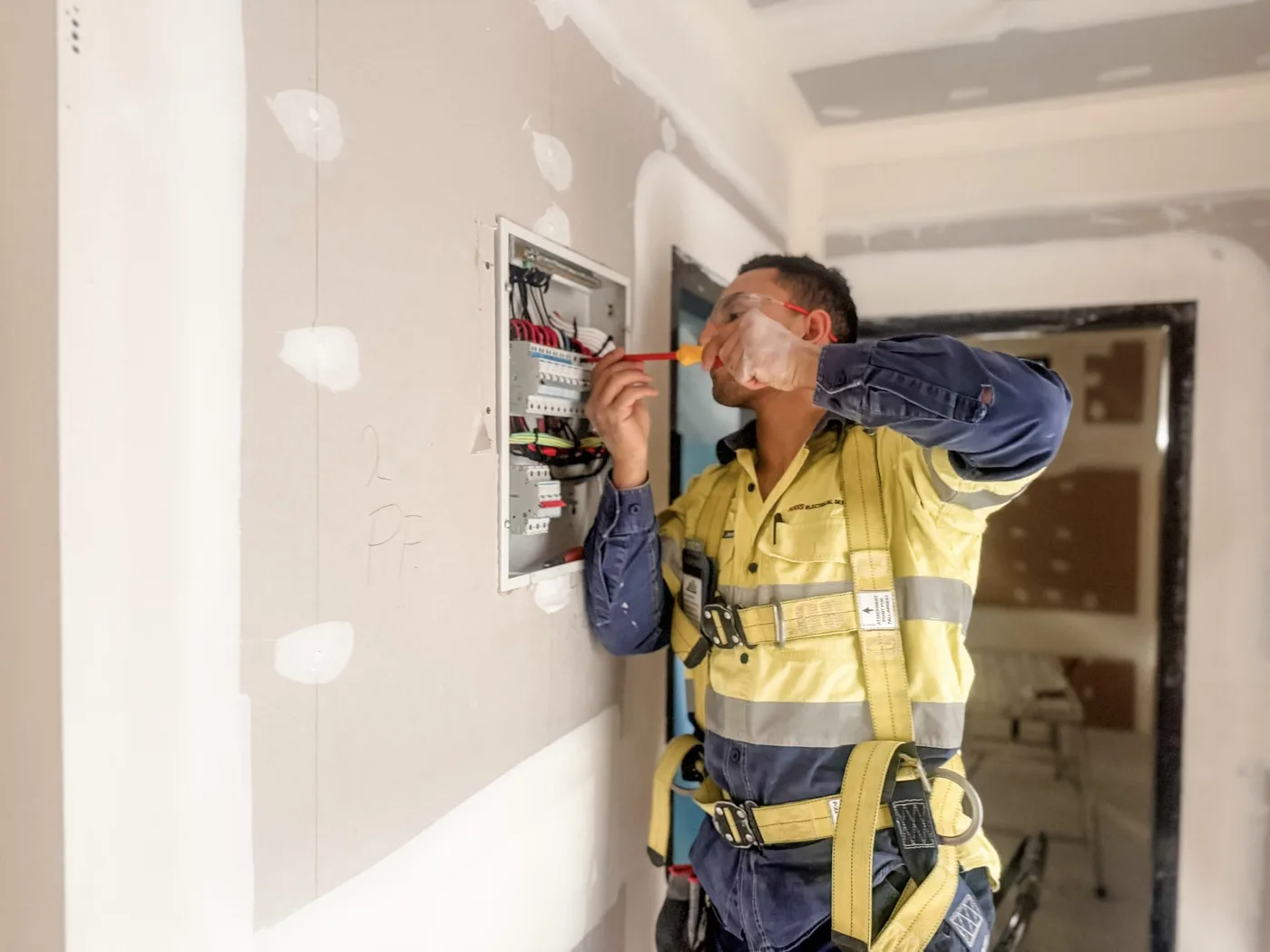
A 1970s house with a 1970s board now runs 2 air conditioners, an induction cooktop, a heat pump hot water system and a home office. A shop that was a newsagent is now a cafe with a 3-phase kitchen. The board was designed for a building that no longer exists. If your board is more than 25 years old and the building's use has changed, get it assessed.
A switchboard assessment takes about 20 minutes on site and is free. We'll tell you which of the 7 signs apply, what's urgent and what can wait.
Need this done rather than read about? See switchboard upgrades or request a free quote.